
what is battery id cards used for?
Battery ID cards (often called Battery Passports or Digital Product Passports) are unique digital profiles assigned to individual batteries. They are used to track a battery’s lifecycle—from raw material sourcing and manufacturing to health, usage, recycling, and disposal.
⏰Key Timeline: From February 2027, the DPP will be mandatory for all electric vehicle batteries, industrial batteries (≥2kWh), and light transport vehicle (LMT) batteries sold in the EU.
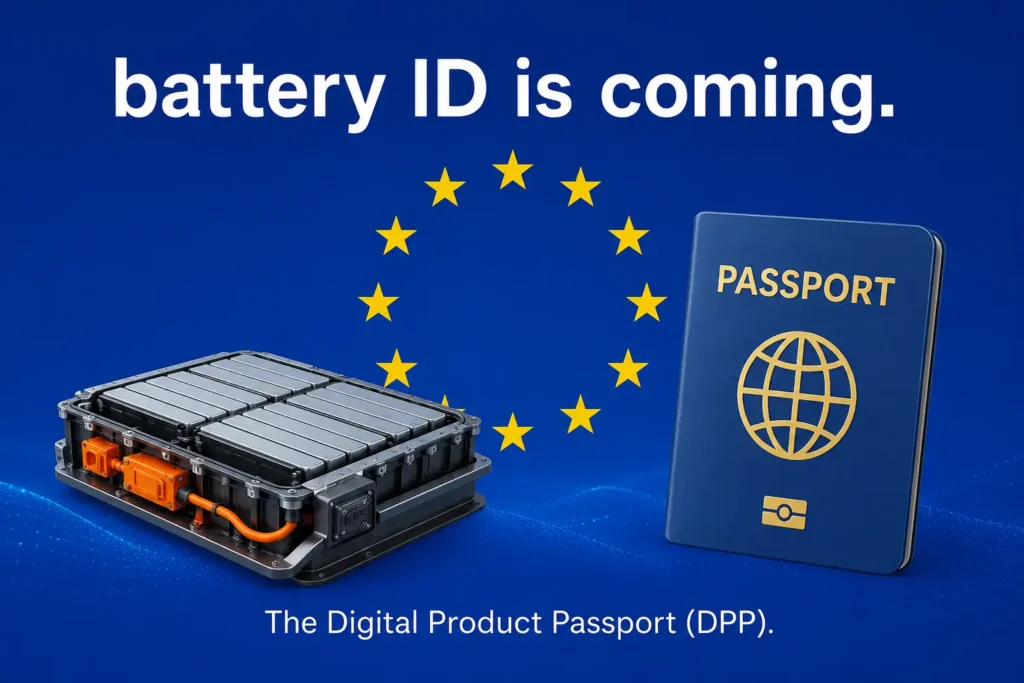
EU Digital Product Passport (DPP) Implementation Guide for the Battery Industry
Source: EU DG GROW Seminar | May 27, 2026
I. What is a “Passport” and What Does It Contain?
DPP stands for Digital Product Passport. Every battery sold in the EU market needs a unique digital identity—accessible via a QR code, linked to a comprehensive product information database.
The passport content is defined by Annex XIII, containing over 100 fields, divided into three levels:
Public Information: Chemical composition, hazardous substances, key raw materials, carbon footprint, capacity, voltage, internal resistance, etc.
Accessible to Legitimate Interests: Detailed ingredient formulas, disassembly manuals, battery health status, usage data, and other sensitive information.
Exclusively for Regulatory Bodies: Compliance test reports, accessible only to certification bodies and market regulators.

II. Who Fills Out the Passport?
The responsible party for the passport is the “economic operator that puts the battery on the market”—usually a battery pack manufacturer or importer within the EU. The economic operator can delegate these obligations to other entities through written authorization.
For Chinese companies, this means:
For cell or pack suppliers providing batteries to European OEMs, the downstream customers (OEMs) are usually the legally responsible party;
However, you must provide them with complete and accurate data—carbon footprint, material composition, and procurement compliance reports are all indispensable;
Once the battery is remanufactured or repurposed, a new passport is generated, and the responsible party transfers accordingly;
Upon battery recycling, the passport is cancelled. Responsibility during the disposal phase transfers to the “Producer Responsibility Organization” or a designated waste management agency.
It is worth noting that the European Commission does not have the authority to further refine the specific fields of the passport, but several reference frameworks are already available in the industry, including the Battery Pass project, the DIN DKE SPEC 99100 standard, and the technical specifications being developed by CEN TC 301.

III. Timeline for Regulatory Infrastructure Progress
The European Commission presented a clear timeline at the seminar:
June 2026
Published the DPP Registry Implementation Regulations + Standard Implementation Decision
July 2026
The DPP Registry officially went live
Q4 2026
Published the Battery Access Permission Implementation Regulations (Article 77(9))
February 2027
⭐ Mandatory implementation of Battery DPP
Q1 2027
DPP Service Provider Delegation Regulations; Building Materials Delegation Regulations
Q2 2027
Digital Certificate Implementation Regulations; Unique Identifier Delegation Regulations
2028
Mandatory implementation of DPP for Packaging, Steel, and Building Materials
2029
Mandatory implementation of DPP for ICT Products, Tires, Aluminum, Textiles, and Detergents
Regarding standardization, CEN/CENELEC JTC24 has completed the formal approval of six core technical standards (Unique Identifier, Interoperability, Data Carrier, API, Data Exchange Protocol, and Data Storage); two more (Authentication and Access Permission Management) will be released later. The ISO-level JTC5 technical committee will be launched in September 2026—the international extension of European standards is underway.
IV. What Enterprises Should Do Now
01. Confirm Legal Entity Identity
Are you a manufacturer, importer, or acting as an authorized agent on behalf of another party within the EU? Different identities mean completely different boundaries of compliance obligations.
02. Assess Data Gaps
Check your existing data system against Annex XIII list item by item—especially carbon footprint (awaiting the implementation of Article 7 obligations) and dynamic data (battery health status needs daily updates).
03. Establish Cross-Border Data Compliance Pathways
Data export compliance is not a matter that can be postponed. The Lingang pilot program provides a limited but workable preliminary path; relevant enterprises should closely monitor its expansion.
04. Systematically Build Digital Infrastructure
DPP is not just a declaration, but a complete system encompassing data production, transmission, storage, and access permissions. International industry data space alliances have provided practical tools; Chinese enterprises can consider the potential for cooperation.
February 2027—this date is closer than many realize.